
Lane County Release Date Meaning
A projected date is a working calculation. The sentencing court sets the legal term, while the agency holding the person applies jail credit, concurrent or consecutive terms, earned credits, and other rules. “Concurrent” terms run at the same time. “Consecutive” terms run one after another. The displayed date can mark the end of just one agency’s custody. Another county, KDOC, a federal authority, or immigration officials may then assume custody.
A pretrial detainee usually has no sentence-based release date. Bond, a court order, dismissal, or a later plea may determine when that person leaves. A person serving a local jail sentence must be checked through the actual receiving jail and Lane County District Court. Someone committed to the Kansas Department of Corrections follows the state sentence-computation path. Those paths cannot be merged into one calculator.
Find Lane County Projected Releases
Begin with the custodian, not a broad name search. Current evidence reports that the former Lane County Jail is closed, although an older directory still lists it. The Lane County Sheriff can identify whether Finney, Scott, Ness, or another jail received the person. That receiving jail controls the live custody and movement entry.
- Call the Sheriff with the full name, date of birth, and approximate arrest date. Ask which jail accepted the booking.
- For a local sentence or pretrial case, ask that jail for its current status and then review the Kansas District Court Public Access Portal, narrowed to Lane County.
- For a state sentence, search KASPER by KDOC number when known or by legal name.
- Compare the identity, sentence, facility, supervision status, and exact date label. Never turn a blank field into an estimate.
- Confirm a time-sensitive date with the displayed facility, supervision unit, or records office.
The full Lane County released-inmate workflow also explains how to pair the eventual custody exit with the court record on the home search. A name that vanishes from a roster does not prove the person returned to the community.
KASPER Lane County Release Dates
KASPER is the Kansas Adult Supervised Population Electronic Repository. It covers adults who are or were in KDOC’s supervised population, including many people sentenced to the Secretary of Corrections since 1980. It does not contain every Lane County jail booking. A person who served only a local term may never appear.
The public detail may show an Earliest Possible Release Date. KDOC also uses “anticipated release date” in its general search guidance. Read the exact live label. An incarcerated status means the person remains in state custody. Parole or post-release supervision means the person is outside prison but remains supervised. Discharged means the correctional relationship displayed by KDOC has ended.
The official KASPER search shows the state interface used for this check.
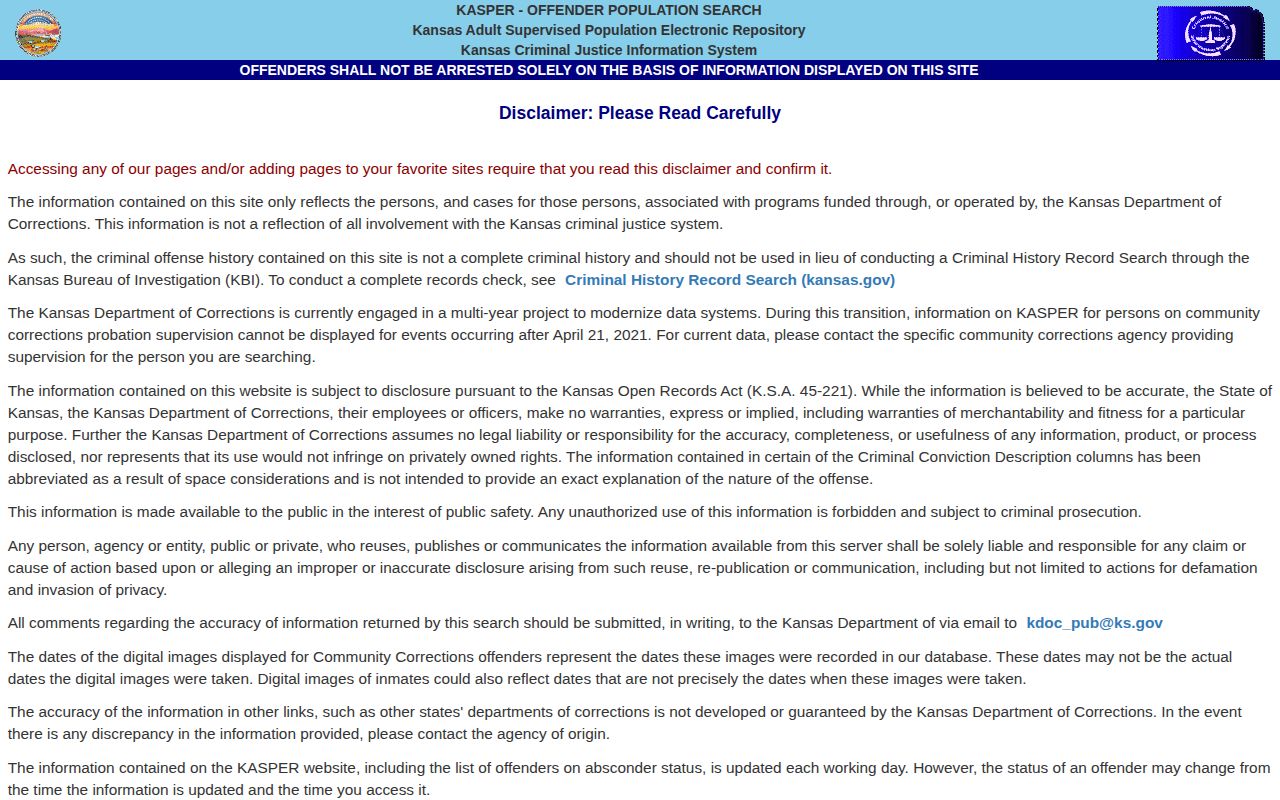
The image identifies the correct Kansas source. A live person record must still be checked for its current status, date label, and supervising location.
| Displayed information | How to read it |
|---|---|
| KDOC number | The best key for distinguishing people with similar names. |
| Institutional location | Shows state placement, not a Lane County jail release. |
| Earliest Possible Release Date | A changeable computation, not a promise of community release. |
| Parole or post-release status | Outside prison while still under KDOC supervision. |
| Discharged | The displayed KDOC sentence and supervision relationship has ended. |
Public KASPER data updates each working day. An operational change can happen before the online record changes, so keep the search date and verify urgent questions directly.
Lane County Good-Time Rules
Kansas does not have one good-time formula for every sentence. Under K.S.A. 21-6821, many crimes committed on or after July 1, 1993 have a maximum good-time allowance of 15 percent. The same law allows 20 percent for certain lower-severity nondrug crimes committed on or after January 1, 2008, and for specified drug severity levels during defined date ranges. Some eligible prisoners may earn up to 120 days of program credit.
Credits remain conditional. They may be lost, restored, or changed under applicable rules. Serious crimes, mandatory minimums, and special sentences may allow less credit or none. Older indeterminate terms may involve parole and conditional-release rules instead of the framework used for a modern determinate sentence. “Determinate” means the court imposed a fixed prison term. “Indeterminate” means release can depend on a minimum, maximum, and parole authority.
County jail time is different. Do not apply KDOC prison percentages to a Lane County receiving jail. Obtain the journal entry from Lane County District Court, ask how jail credit was entered, and let the actual custodian explain its calculation.
Note: The sentence, offense date, severity level, credits, and any mandatory minimum must be known before the statute can be applied.
Lane County 85 Percent Myth
The familiar claim that every Kansas prisoner serves 85 percent is not a safe Lane County release calculator. It describes only one part of the good-time framework for some state sentences. The statute itself has offense-date and severity exceptions. Program credit can also matter, while special sentences and mandatory terms follow other rules.
A county booking may end through bond, time served, probation, dismissal, or transfer. None of those outcomes can be predicted by multiplying a sentence by 0.85. An older parole-eligible term calls for the journal entry, offense date, sentence structure, applicable credits, and any board action. The result should then be checked against the live KASPER record.
This distinction is especially important in Lane County. A person may first be booked in a receiving county and later move to KDOC. The receiving jail’s exit date and KDOC’s earliest possible release date describe two separate custody stages.
Why Lane County Dates Change
A date can move after the first calculation. Some changes shorten the estimate. Others extend it or block community release even after one sentence ends.
| Change | Possible effect | Record to verify |
|---|---|---|
| Amended journal entry | Changes the controlling sentence or its structure. | Lane County District Court case |
| Jail-credit correction | Adds or removes credited days. | Court order and custodian computation |
| Consecutive case | Places another term after the first. | All sentencing entries |
| Good-time action | Loss, restoration, or earned credit alters the estimate. | KDOC sentence computation |
| Detainer or hold | Another authority takes custody when the term ends. | Movement record and receiving authority |
| Board action | Affects eligible parole or conditional release. | Board action and later KASPER status |
A detainer is a request or legal hold from another authority. It can mean that release from one agency is a transfer, not a return to the community. Data corrections may also change the public display without changing the underlying court sentence.
Lane County Parole Date Limits
Modern Kansas guidelines sentences often end the prison portion with mandatory post-release supervision. That is not the same as discretionary parole. Older indeterminate, off-grid, and specially governed sentences may still require a Kansas Prisoner Review Board decision under K.S.A. 22-3717.
A hearing calendar gives notice of a future proceeding. It is not a release decision. Even a favorable outcome may depend on an effective date, approved plan, detainer, or another condition. Verify the later KASPER status and request the formal board action when the exact result matters.
The Lane County parole and probation record path separates board decisions, KDOC field supervision, and court probation. That separation prevents an eligibility month from being mistaken for an actual exit date.
Confirm Lane County Release Dates
A final check should join the sentence, the calculation, and the movement. Start with the Lane County District Court journal entry. It states the court’s sentence and can show whether terms run together or one after another. Then identify the actual custodian. For a local booking, Lane County Sheriff should name the receiving jail. For a state term, KDOC maintains the sentence computation and KASPER display.
The court register and jail movement entry serve distinct purposes. A bond order, dismissal, or sentencing entry explains the legal authority for change. The physical release time belongs to the jail’s record. If that movement says transfer, identify the next authority before describing the person as released. One date can be correct for the jail even though another agency begins custody that day.
Name searches need care. Try known legal spellings, but never select a namesake from name alone. Compare date of birth, KDOC number, conviction entries, and location. A public photograph may aid identification, though it cannot replace the other fields. When KASPER leaves the future-date field blank, contact KDOC instead of constructing a date from the sentence text.
Sentence aggregation can change the result. Several cases may run concurrently or consecutively. Jail credit may apply differently to each case, and an amended journal entry can correct the computation. A disciplinary credit decision can also change an estimate without changing the court’s original term. Keep the date and source of each record so later changes can be traced.
Some Lane County cases never reach a prison calculation. Pretrial release depends on bond or another court order. A time-served judgment can lead to exit after the receiving jail processes the paperwork. Probation moves the person to a court-supervised sentence. Dismissal can end one basis for detention, while a separate warrant or hold may prevent departure.
For a documented federal transfer, the Bureau of Prisons locator applies only when the person enters the sentenced federal population it covers. A pretrial federal detainee may instead be held under U.S. Marshals authority. An immigration transfer follows the ICE locator route. Neither should be called a Lane County community release solely because the county booking ended.
Eligibility and suitability are different too. Eligibility means a sentence permits consideration. Suitability is the board’s decision under the applicable process. A pass is a denial with a later review period. A continue allows more deliberation, information, votes, or evaluation. Neither term is an actual release event. Confirm the later KASPER status or obtain the formal board record.
Finish by asking what the date represents. It may be an earliest possible release, sentence discharge, parole eligibility point, or end of one custodian’s hold. Copy the label exactly. Then verify the completed event with the office whose authority ended and check whether another authority immediately assumed custody.